To always round down (toward zero), use the ROUNDDOWN function. To round a number to a specific multiple (for example, to round to the nearest 0.5), use the MROUND function.
ROUND takes two arguments, number and num_digits. Number is the number to be rounded, and num_digits is the place at which the number should be rounded. When num_digits is greater than zero, the ROUNDfunction rounds on the right side of the decimal point.
In this article, I will explore all the key roundingfunctions in Excel, explain how they work, and demonstrate how to use them effectively through practical examples.
In this comprehensive guide, we’ll cover everything you need to know about using the ROUNDformula in Excel, including its syntax, examples, and common use cases. What is the ExcelROUNDFunction? The ExcelROUNDfunction is a built-in formula that allows you to round a number to a specified number of digits.
Now, let us learn how to use RoundExcelfunction to round up a number. The steps used to obtain a rounded value in Excel are as follows: Step 1: First, we must select an empty cell to display the result. So, let us select cell B1. Step 2: Next, enter the formula =ROUND (A1,0) in cell B1. Step 3: Then, press Enter key.
And Microsoft Excel provides a handful of functions to handle different rounding types. Below, you will find a quick overview of the major roundfunctions and well as formula examples that demonstrate how to use those functions on the real-life data in your worksheets.
The ExcelRoundfunction rounds a supplied number up or down, to a specified number of decimal places. The syntax of the function is: Where the arguments are as follows: The initial number. The number of decimal places to round the supplied number to.
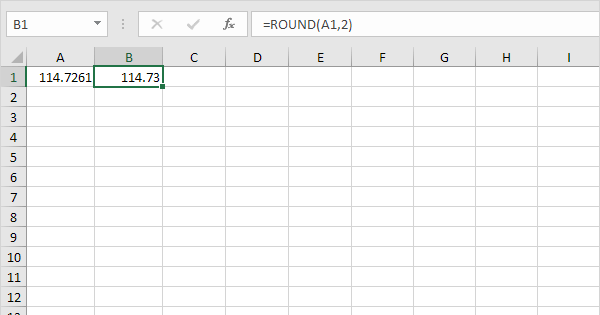 This chapter illustrates three functions to round numbers in Excel. ROUND, ROUNDUP and ROUNDDOWN.
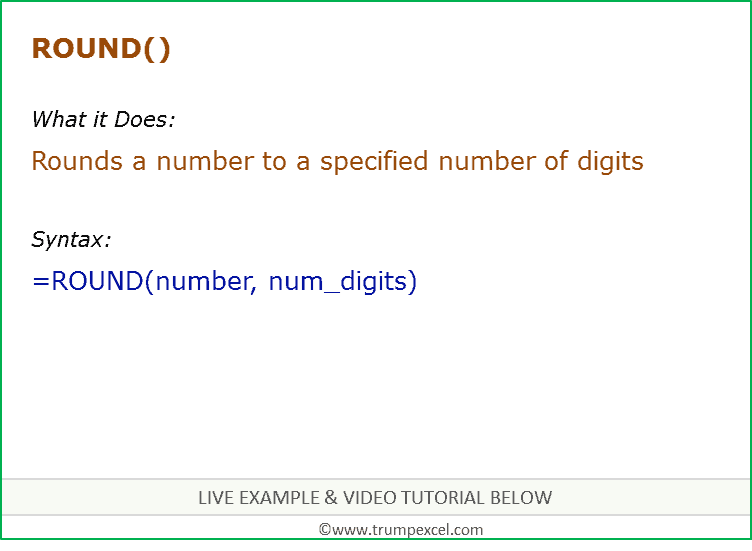 In this tutorial, learn how to use Excel ROUND Function. ROUND is a math function that rounds a number to a specified number of digits.